

Why Saving Time on Work Management Tool Starts with Your People
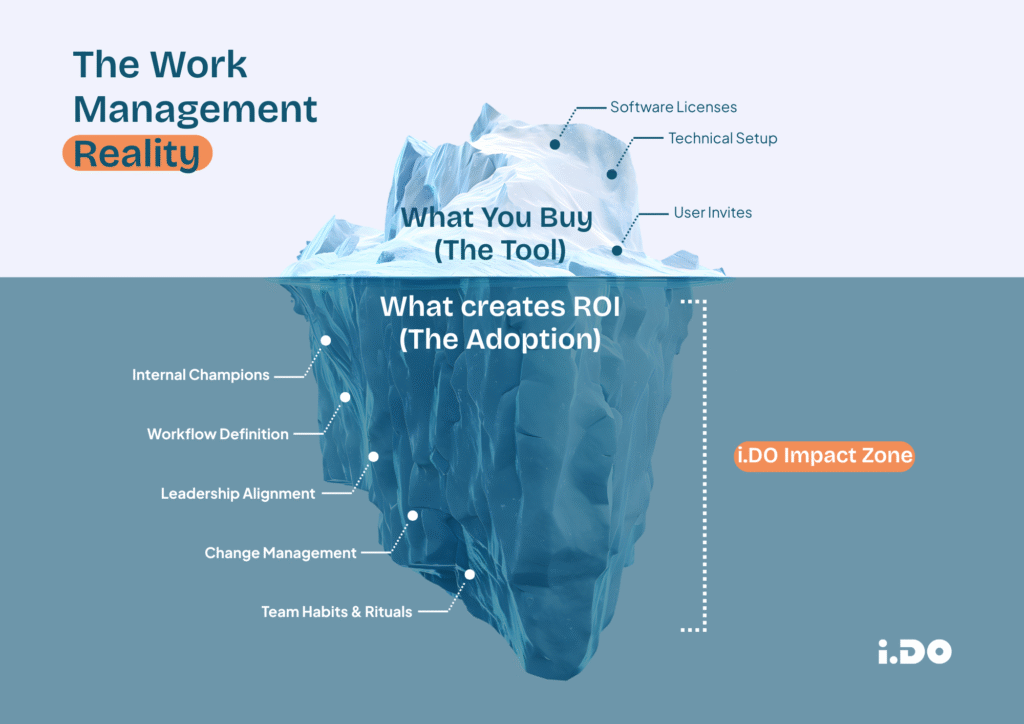
You’ve invested in a leading work management platform. You expected streamlined workflows and clear visibility. Instead, you’re hearing complaints. “It’s too complicated”, “I prefer email”, or “Why do I have to update this manually?”.
When adoption stalls, the easiest target is the software itself. It’s tempting to think, “Maybe Asana isn’t right for us”, or “Maybe we need a different tool.”
At i.DO, we see this constantly. But here is the hard truth: the tool is rarely the problem. The chaos usually stems from how the tool was introduced to the humans who use it.
Operational efficiency isn’t a feature you buy; it’s a habit you build. Here is why saving time starts with stopping the blame game and investing in your internal champions.
Why Software Implementation Fails Without an Adoption Strategy
About workflow optimization, many organizations fall into the trap of treating software implementation as a purely technical task. IT installs it, accounts are created, and management expects magic.
But for teams in high-pressure industries (whether you are a large multinational, or a small local agency), a new tool often feels like more work, not less. Without guidance, the tool becomes a graveyard of outdated tasks, and teams retreat to what they know: spreadsheets and endless emails.
To fix this, you don’t need a software patch. You need a people strategy.
The Solution: Internal Champions
The secret to every successful rollout we’ve guided isn’t a complex API integration; it’s the présence of Internal Champions.
Who are they?
Champions are the power users hiding in plain sight. They are the project managers, coordinators, or team leads who naturally understand how to organize chaos. They see the vision. They want to work smarter, not harder.
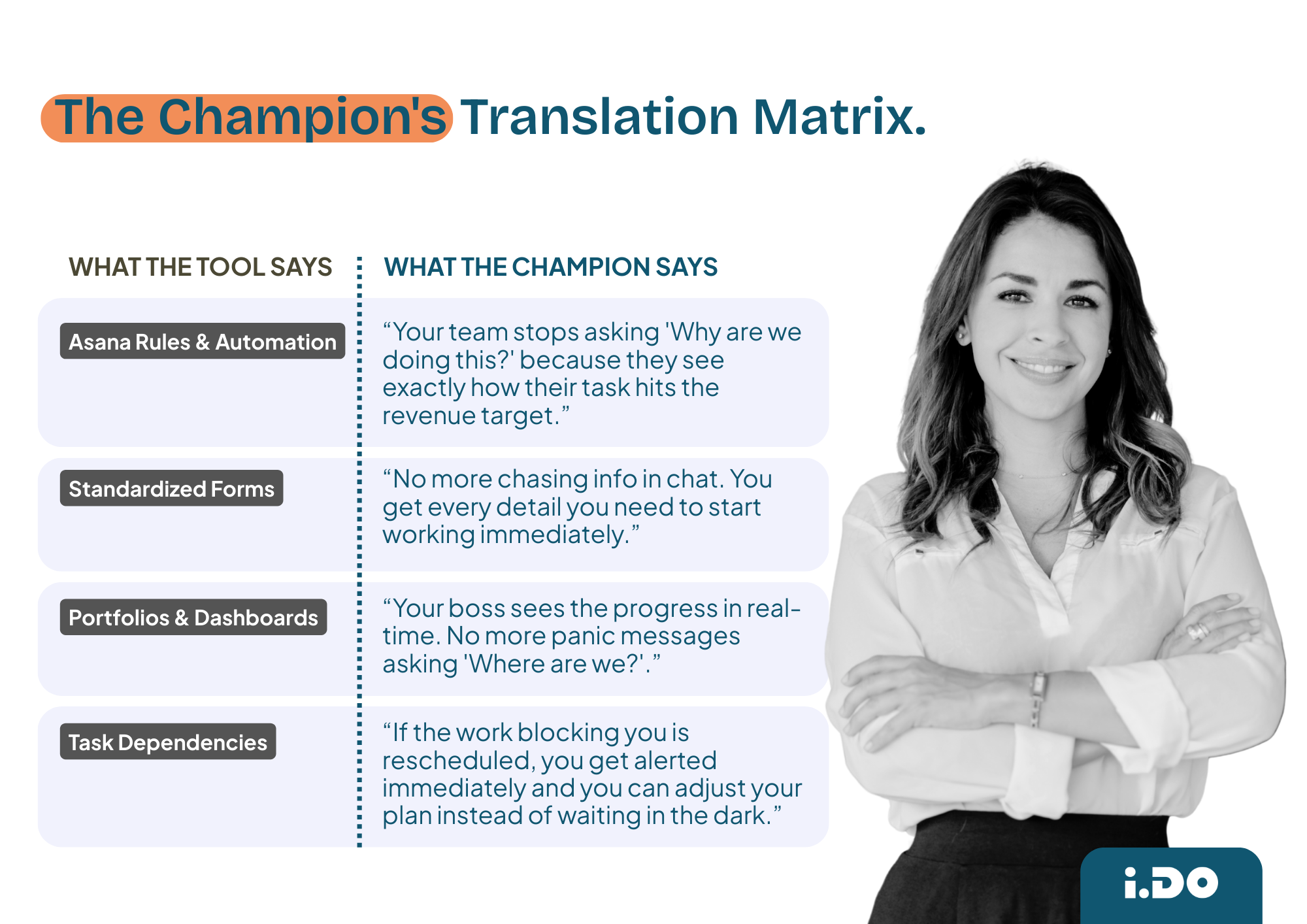
Champions act as the bridge between the tools capabilities and your team’s daily reality. They translate “features” into “benefits”.
- Feature: “Asana Rules”
- Champion’s translation: “I can set this up so you never have to manually email design again.”
Empowering them to lead
A champion cannot drive change alone. As a leader (COO, PMO, C-Level), your role is to back them up:
- Recognize them: Acknowledge that their work on the tool is a valuable business contribution, not a side hobby.
- Grant Authority: Give them the mandate to establish Asana best practices.
- Protect their time: Allow them dedicated hours to support their peers and maintain the system.
Moving from “User” to “Owner”
If you want to secure long-term adoption, consider formalizing this responsibility. We recommend moving towards a dedicated Asana Role (or Work Management Lead).
This person stops being just a user and becomes the Architect of your Work.
- In Professional Services: They ensure client onboarding projects are duplicated from a perfect template every time, ensuring consistency and saving hours of setup.
- In Industrial Sectors: They manage the portfolio view, giving executives real-time data on production timelines without needing to ask for a report.
The Result: True ROI (Time & Money saved)
When you stop blaming the tool and start training your people, the results become measurable.
- You Save Time: Status meetings are replaced by asynchronous updates. “Work about work” disappears.
- You Save Money: You stop paying for unused licenses (“shelfware”) and reduce the risk of costly project delays due to miscommunication.
- You Gain Clarity: Priorities become clear, and the mental load on your teams decreases.
Tools don’t transform organizations, people do. Asana is the engine, but your team is the driver. If you don’t teach them how to drive, the car won’t go anywhere.
By investing in the champions behind your work management platform, you turn frustration into flow.