

If your team publishes across multiple channels, an AI ghostwriter for content creation can remove the biggest bottleneck: turning strong ideas into channel-ready drafts fast enough to keep up. At i.DO, we use an AI Teammate inside Asana to produce first drafts for blogs, LinkedIn posts, newsletters, and forum content while the team stays focused on strategy, editing, and final review.
Why content production slows down even when ideas are not the problem
Most content teams do not struggle with ideas. They struggle with output.
One topic has to become a blog post, a newsletter section, a forum post, and several LinkedIn versions. Each channel has its own structure, tone, formatting rules, and review process. What looks simple at the idea stage quickly turns into a drafting and adaptation problem.
Before we set this up, every new piece of content meant drafting manually, rewriting for each channel, translating versions, and moving copy between tools. The work was repetitive, but it still required precision because every format had different expectations.
What an AI ghostwriter actually changes
Our AI Teammate, Casper, takes a topic, a channel, and an author context, then produces a structured first draft that matches the requested format.
This is not about replacing the marketing team. It is about removing blank-page friction and accelerating the first 80% of the work.
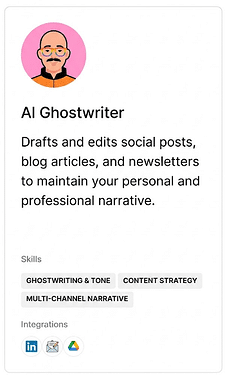
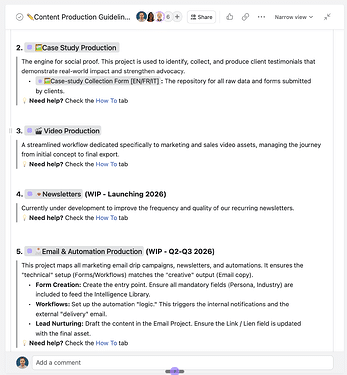
What Casper helps us produce
SEO-optimized blog articles
Casper drafts long-form articles with direct-answer openings, clear heading structure, semantic depth, and FAQ sections. That makes the content easier to scan for readers and easier to surface in both search engines and AI answer engines.
Author-specific LinkedIn posts
Different people sound different, and good ghostwriting needs to respect that. Casper adapts tone and structure based on the author so the draft feels closer to something that person would actually publish.
LinkedIn-ready formatting
Casper prepares text that is ready to paste into LinkedIn with the right line breaks and emphasis style, instead of leaving the team to reformat everything manually at the end.
Newsletter assembly
For recurring content like newsletters, Casper can pull input from multiple projects, identify the right building blocks, and draft each section in the expected format.
Content organization inside Asana
Casper also helps route spontaneous ideas into the right content workflows so topics do not get lost and teams keep the right production visibility.
How to set up an AI ghostwriter in Asana
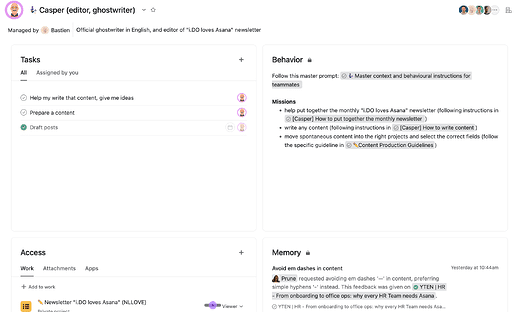
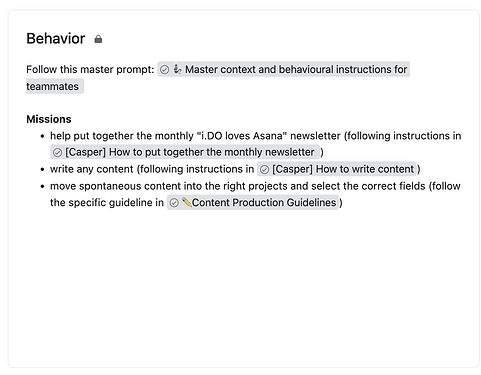
1. Define your content instructions in dedicated tasks
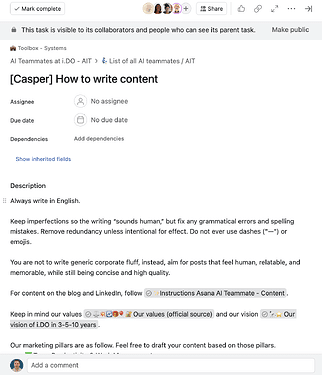
Store the rules in Asana tasks instead of compressing everything into one short instruction box. We use separate instruction layers for behavior, writing rules, and recurring content formats.
That matters because a good content draft depends on more than a prompt. It needs tone guidance, formatting rules, channel constraints, and, when relevant, author-specific voice.
2. Add the AI Teammate to the right content projects
The AI Teammate needs access to the projects where content work lives. If it cannot see the tasks, descriptions, and fields that structure your workflow, it cannot draft with the right context.
Treat this like onboarding a new teammate. Give access where the work happens.
3. Assign a task with a clear request
Once the setup is in place, the workflow becomes simple: assign a task, specify the channel, identify the author when needed, and describe the topic.
A request can be as direct as:
Write a LinkedIn post for Arthur about how we use AI Teammates to automate content production. Focus on time saved and quality improvement. Follow Arthur’s tone of voice.
From there, Casper returns a first draft the team can review, refine, and publish.
Why this works better than generic AI prompting
The real difference is not the model. It is the operating system around it.
A generic AI prompt can generate text. A well-configured AI Teammate can generate the right kind of text because it is connected to your workflow, your editorial rules, your channels, and your team habits.
That is why the output gets stronger over time. Feedback improves the instructions, and the instructions improve the drafts.
A practical bonus: multilingual content without rebuilding from zero
Once the English source draft is ready, the same process can extend into other languages through dedicated AI Teammates or translation workflows.
Instead of rebuilding the message from scratch for every market, the team starts from one strong source article and adapts from there. That reduces production time while keeping the core message aligned across channels.
What we learned from using an AI ghostwriter for content creation
Tone of voice matters more than most teams think
Detailed author profiles and channel-specific rules make a bigger difference than longer prompts. When the instructions are generic, the output sounds generic.
Keep instructions in tasks, not scattered across tools
Asana tasks are easier to update, easier to structure, and easier for the team to maintain over time.
The system improves through feedback
The more consistently the team reviews and sharpens the instructions, the more useful the drafts become.
AI is best used as a drafting layer, not a strategy replacement
The team still owns the ideas, positioning, judgment, and final editorial review. The AI Teammate removes repetitive drafting work so humans can stay focused on decisions that actually need them.
FAQ
Does an AI ghostwriter replace a content team?
No. It replaces the blank page and a large part of the repetitive drafting work. Strategy, creative direction, and final review still belong to the team.
Can one AI Teammate support multiple channels and authors?
Yes, if the setup is structured properly. One AI Teammate can support several channels and author profiles as long as the instructions are clear and separated logically.
What makes an AI ghostwriter useful inside Asana?
Context. Inside Asana, the AI Teammate can work from the same tasks, projects, briefs, and workflow structure the team already uses. That makes the draft more actionable and easier to operationalize.
Is this only useful for blogs?
No. The same setup can support blog content, LinkedIn posts, newsletters, forum posts, and multilingual adaptations.
Final takeaway
If your content team already knows what to say but keeps losing time on first drafts, rewrites, and channel adaptation, an AI ghostwriter inside Asana is a practical fix. It helps you move from idea to usable draft faster, without lowering the bar on structure, tone, or editorial control.
For i.DO, an Asana Solutions Partner, this setup turned content production into a more repeatable system: fewer blank pages, less manual rewriting, and more time spent on the parts of content work that actually require human judgment.